
Rio Grande Criminal Court Records
A criminal court record is the case-level file maintained once a criminal matter opens in court. In Rio Grande County, that file may include the complaint or information, advisement entries, bond orders, motions, plea paperwork, minute orders, disposition and sentence orders, protection orders, and ticket-related records. It can show what the prosecution filed, how the defendant responded, what hearings occurred, and how the case ended. The charge-focused path is narrower and is covered by Rio Grande County arrest records and court charges.
Criminal jurisdiction depends on the court level. District Court handles felony cases and related serious criminal matters. County Court handles misdemeanors, felony advisements, criminal traffic, and other limited-jurisdiction criminal matters. Municipal courts may handle local ordinance, parking, and municipal traffic matters. The Clerk of Court keeps the court file; the sheriff keeps arrest, jail, report, warrant, and civil-process records; the 12th Judicial District Attorney prosecutes criminal cases; and the Public Defender serves eligible defendants, not third-party record requesters.
Search Rio Grande Criminal Records
Start with the Colorado Judicial docket search when the goal is to locate a criminal case number, hearing date, court type, case class, or defendant name match. Use County = Rio Grande County or Courthouse = Rio Grande Combined Court. Use Court Type = Both if the level is unknown. Criminal cases may use CR, M, T, JD, or R-style categories depending on the matter. Once the docket identifies a case, use the statewide record request form or the Clerk of Court for the complaint, information, disposition, sentence order, or register of actions.
- Open the docket search and choose a date range.
- Add Rio Grande County, Rio Grande Combined Court, or another non-date filter.
- Search by case number if the year, case class, and sequence are known.
- Search by defendant name if the case number is unknown.
- Request complaint, disposition, sentence, ticket, or protection-order copies through the court record request form.
CBI criminal history is different. The CBI Internet Criminal History Check is the official name-based statewide criminal-history route, while a Rio Grande County criminal court record is the actual case file in court.
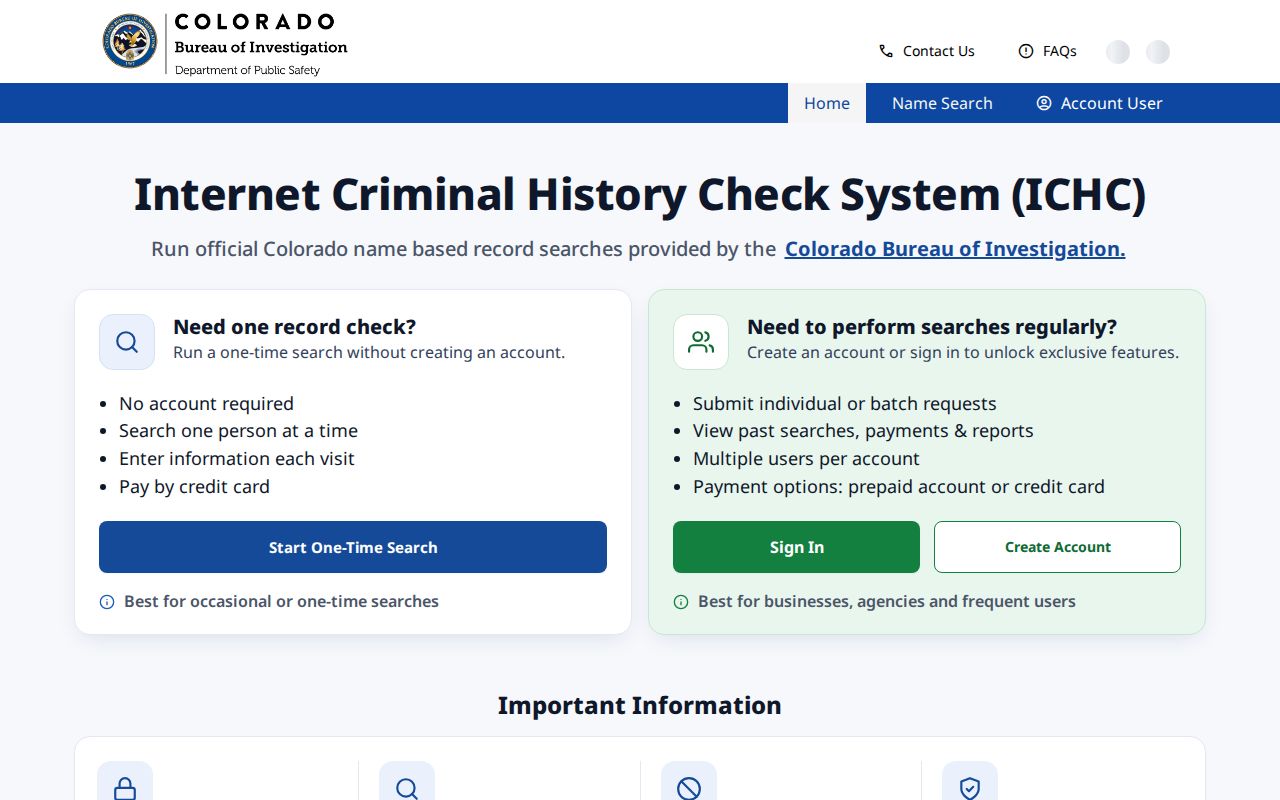
Use CBI for a statewide history check, and use Colorado Judicial or the Clerk of Court for case documents from Rio Grande County.
Rio Grande Criminal Case Stages
A criminal case file grows as the case moves from filed charges to final outcome. The first record may be a complaint, information, ticket, or other charging document. Advisement and arraignment entries show early rights, charges, bond, and plea steps. Pretrial entries can show motions, settings, continuances, protection orders, and negotiations. The case then ends through dismissal, plea, trial verdict, deferred disposition, sentence, or another court order.
Case flow: Charges Filed › Arraignment › Pretrial and Motions › Plea or Trial › Disposition › Sentencing
| Stage | What Happens |
|---|---|
| Charges filed | The prosecution files the formal allegation in court, often by complaint or information. |
| Advisement or arraignment | Rights, charges, bond, plea, and next settings may be addressed. |
| Pretrial and motions | The parties file requests, exchange positions, address evidence, and set hearings. |
| Plea or trial | The case is resolved by plea, trial verdict, dismissal, or other authorized outcome. |
| Disposition and sentencing | The court records the result and any fines, jail, probation, restitution, or other terms. |
Rio Grande Criminal Record Fields
A Rio Grande County criminal court record can show the case number, case class, defendant, attorneys, charges, statutes, hearing dates, judicial officer, bond entries, docket events, plea, disposition, sentence, and financial obligations. The court's record request form describes a register of actions as a brief explanation of the case that can include charges, sentences, and minute orders. That wording is useful because it ties the docket, charge record, and final criminal case file together without treating an arrest record as the court file.
| Field | What It Shows |
|---|---|
| Case number | Year, case class, and sequence used by the court. |
| Defendant | The person accused in the criminal case. |
| Charges | Offenses filed by the prosecution, with statute or code context when shown. |
| Plea | The defendant's response, such as guilty, not guilty, or another court-accepted plea. |
| Hearings | Advisement, arraignment, pretrial, motions, trial, review, and sentencing settings. |
| Disposition | The outcome for each charge or the case as a whole. |
| Sentence | Jail, probation, fines, costs, restitution, treatment, or other court-ordered terms. |
Rio Grande Charges vs Convictions
A charge is an accusation filed in court. A conviction is the result after a guilty plea, court finding, or jury verdict that establishes guilt for a charge. A Rio Grande County criminal court record may show charges that were amended, reduced, dismissed, or resolved without conviction. It may also show multiple counts from one arrest, with different outcomes for each count. Reading only the first charge line can lead to a wrong conclusion.
| Charge | Conviction | |
|---|---|---|
| Stage | Filed allegation. | Final guilty plea or finding. |
| Proof level | Based on probable cause and charging decision. | Requires a plea, verdict, or court finding. |
| Record value | Shows what was alleged. | Shows what was proven or admitted. |
| Risk | Can be dismissed or changed. | Can affect sentence, supervision, and background checks. |
Rio Grande Criminal Case Agencies
The 12th Judicial District Attorney serves Rio Grande County along with Alamosa, Conejos, Costilla, Saguache, and Mineral counties. The official DA homepage lists Anne E. Kelly as District Attorney. That office is the prosecution agency, meaning it files and handles criminal charges in court. The DA victim-services page also directs victims to docket search, rights, restitution, compensation, and Victims' Rights Act information.
The DA victim-services source helps explain how Rio Grande County criminal court records connect to docket tracking and victim rights.
Victim services do not provide public case files, but they show why accurate docket and disposition information matters.
The Colorado State Public Defender Alamosa office serves Rio Grande County. The office address is 610 Main St, Alamosa, CO 81101, phone 719-589-9615, fax 719-589-6178, and email Alamosa@coloradodefenders.us. The Public Defender represents eligible defendants. It is not the custodian for third-party criminal records, so records questions still go to the clerk, CBI, sheriff, municipal court, or DA depending on the record.
The Alamosa Public Defender office is the official defender office serving Rio Grande County cases.
Eligibility and representation questions belong with the Public Defender, while public record copies remain with the court custodian.
Rio Grande Criminal History Checks
CBI's Internet Criminal History Check is a name-based statewide search and is not the same as a court case file. CBI says first name, last name, and date of birth are mandatory, while Social Security number is optional but can improve matching if known. The research file lists the CBI ICHC fee as $6.00 and CHRI request as $13.00. The court record request form itself points users seeking statewide criminal-history arrest records to the CBI system.
The CBI fees and forms page provides the statewide background-check fee context that is separate from Rio Grande County criminal court records.
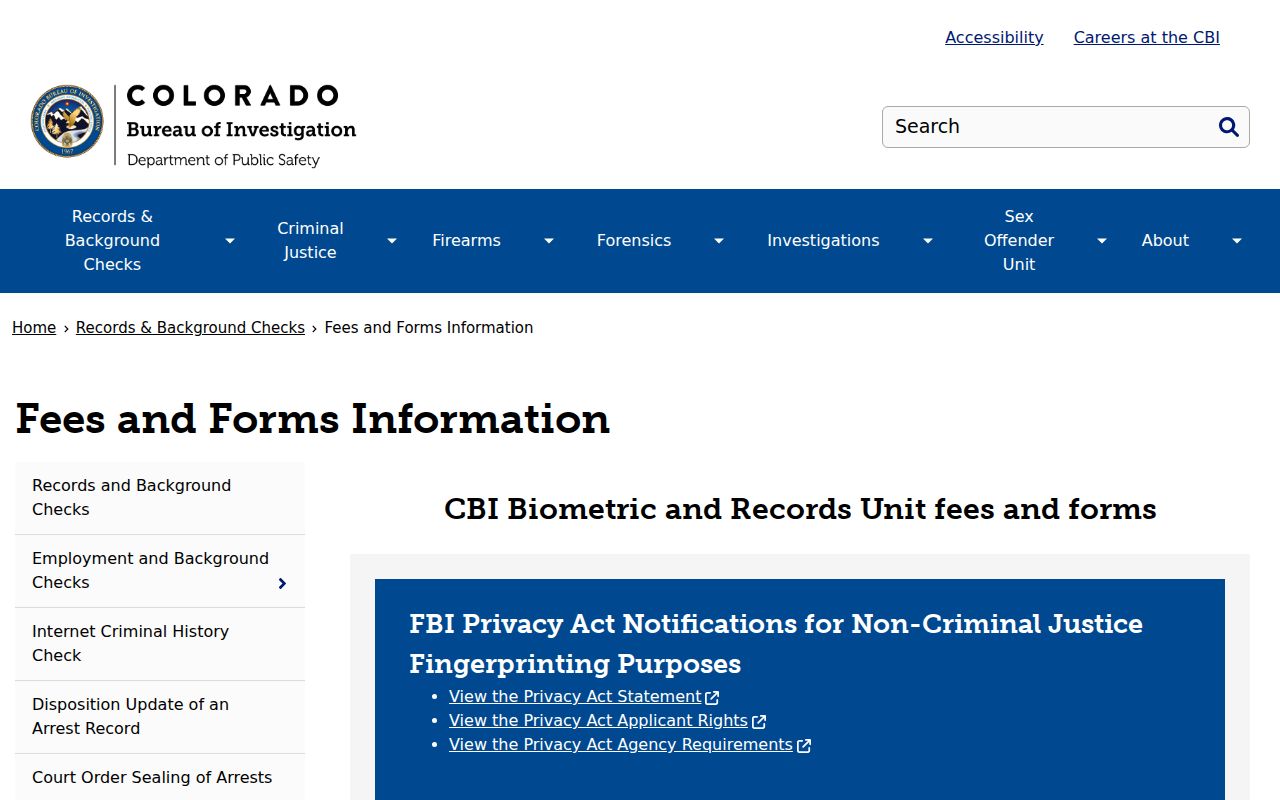
When exact case documents are needed, the court file is still the better source than a name-based history result.
Sealed Rio Grande Criminal Records
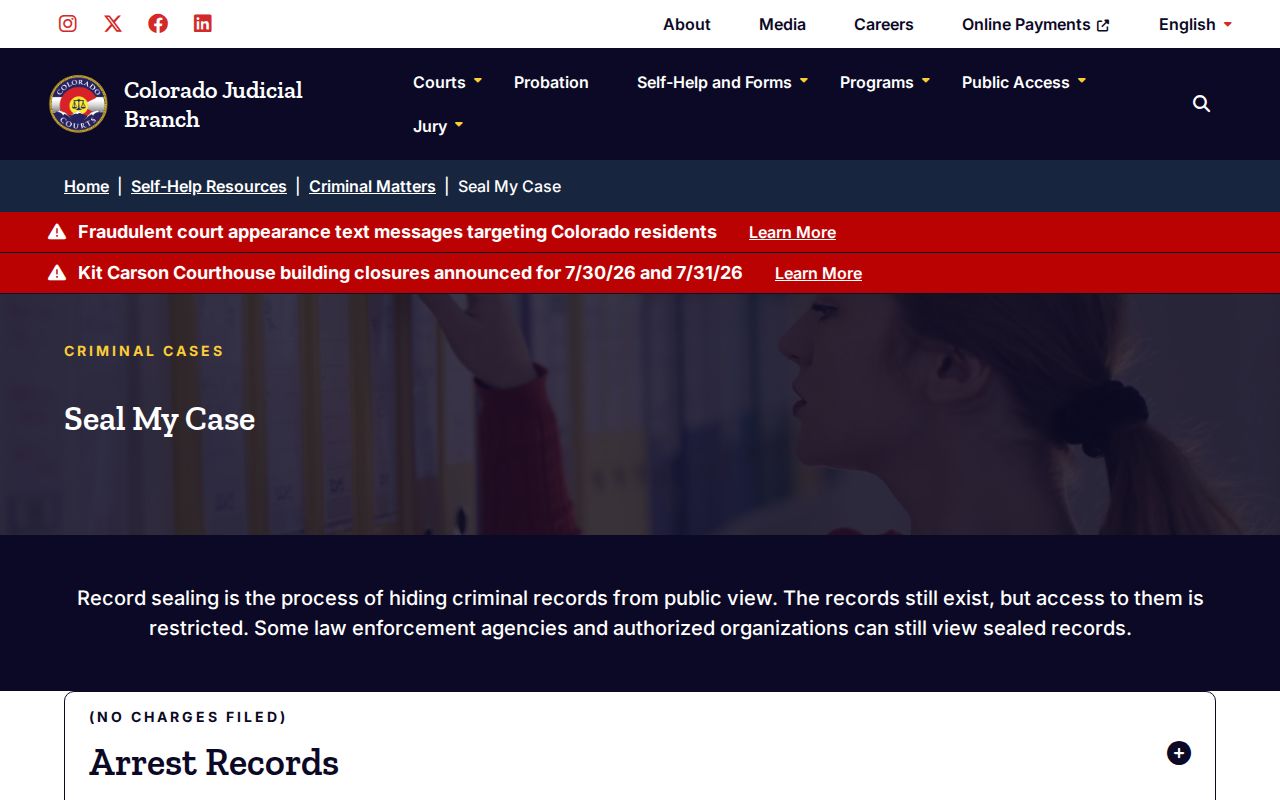
Colorado uses several sealing paths for criminal justice records and court records. The Colorado Judicial Seal My Case page separates arrest records where no charges were filed, county and district conviction records, non-convictions, municipal convictions, multiple cases, identity theft, and special requests. A person often needs the case number, court location, disposition, and proof that sentence or waiting-period conditions have been met.
The Seal My Case source is the official starting point for Rio Grande County criminal court records that may qualify for public-access restrictions.
Sealing can hide records from public view, but courts, prosecutors, law enforcement, and authorized agencies may still have lawful access.
| Sealed | Expunged | |
|---|---|---|
| Public visibility | Restricted from ordinary public view. | Used in some juvenile contexts to treat the record as removed from public access. |
| Record existence | The record still exists with limited authorized access. | The legal effect is narrower and depends on the case type and law. |
| Where to start | Colorado Judicial sealing instructions and the filing court. | Colorado Judicial juvenile or case-specific instructions. |
Access Rio Grande Criminal Records
Public access to Rio Grande County criminal court records depends on the custodian and record type. Court case access is controlled by Colorado Judicial Branch rules and directives, including CJD 05-01 and P.A.I.R.R. Criminal justice records held by law enforcement, such as sheriff reports or arrest records, are governed by the Colorado Criminal Justice Records Act, C.R.S. 24-72-301 et seq. Sealing provisions include C.R.S. 24-72-703 to 24-72-710. For in-person or email help, contact Rio Grande Combined Court at 925 6th Street, Room 204, Del Norte, or riograndeclerk@judicial.state.co.us.
Note: Juvenile, sealed, suppressed, and protected criminal records may require ID, party status, a court order, or may be denied.
Restricted Rio Grande Criminal Records
Juvenile criminal matters should not be treated as generally public. Suppressed cases may not show in docket search, and sealed criminal records may show limited or no public information. Redactions can protect Social Security numbers, full financial account numbers, minor names, victim identifiers, protected addresses, medical details, and other data protected by law or court order. For municipal convictions, contact Monte Vista Municipal Court or Del Norte Municipal Court as appropriate rather than assuming the state combined court has the whole file.
For missed court, bench warrant, or bond questions, verify the docket and then contact the issuing court or sheriff. A warrant issue may be tied to a criminal case record, but active warrant status should be confirmed through official court or sheriff channels rather than stale third-party results.